
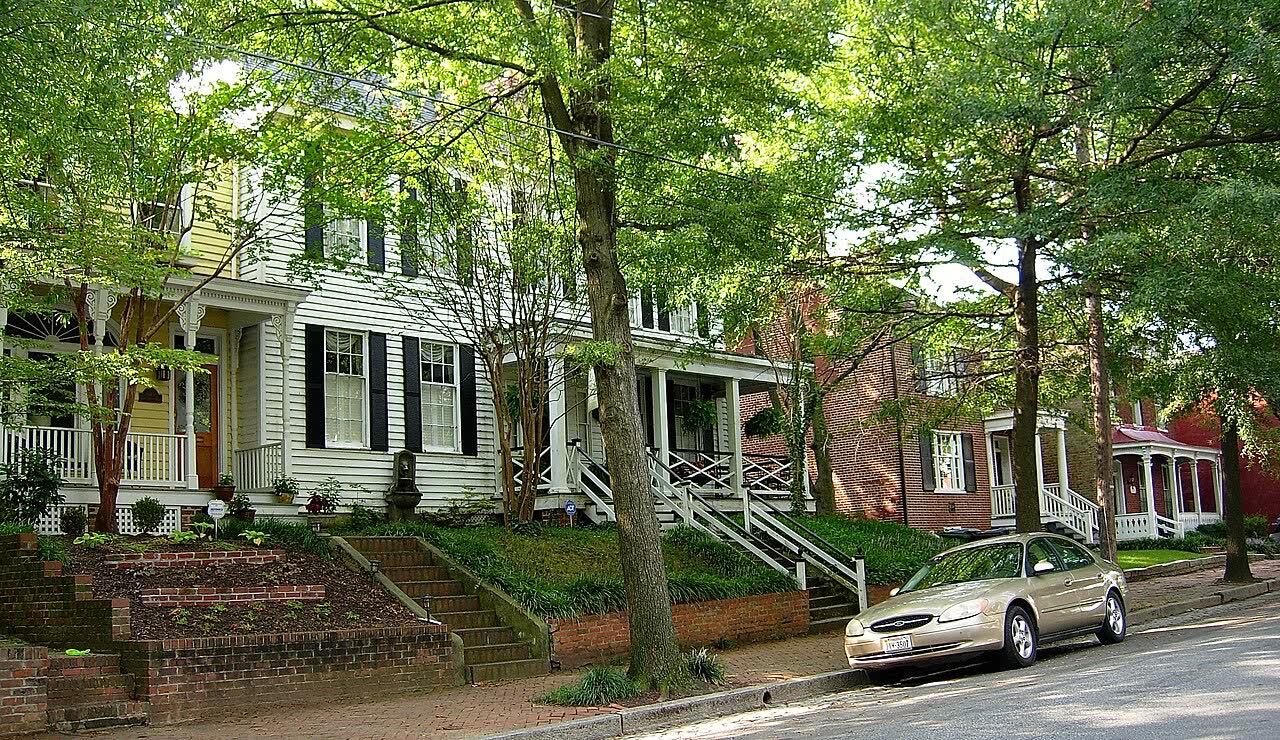

From Main Street, you reach it by climbing. The GRTC Pulse runs along Main Street at the foot of the bluff, the walk up from there is steep, and at the top you're on a grid of narrow streets and older row houses, with parks and river views a few blocks from most front doors.
Where is Church Hill?
Church Hill sits in the City of Richmond, the capital of the Commonwealth of Virginia, east of Shockoe Bottom, on the high ground between Broad Street and the river. Its historic core, the St. John's Church Historic District, is roughly bounded by 22nd Street, Marshall Street, 32nd Street, Main Street, Franklin Street and Williamsburg Avenue, according to its National Register listing.
In everyday use, "Church Hill" also takes in the blocks north of that core, including Church Hill North and Union Hill, both of which the City treats as historic districts of their own, and Chimborazo to the east. The neighborhood is in City Council's 7th District (East End), represented by Council President Cynthia I. Newbille as of October 2026. The Church Hill Association is the long-running nonprofit civic group.
Church Hill uses ZIP 23223. That ZIP also covers Shockoe Bottom, Fulton, Fairfield and part of eastern Henrico County, so a 23223 address alone does not put a home or business in Church Hill, or even in the City.
What is the history of Church Hill?
Church Hill grew around St. John's Church, built in 1741 at 2401 East Broad Street. Patrick Henry gave his "Give me liberty, or give me death" speech there during the Second Virginia Convention on March 23, 1775, when the building was Henrico Parish Church, according to the Patrick Henry National Memorial at Red Hill.
The St. John's Church Historic District was added to the National Register of Historic Places in 1970 (reference 70000884), with a boundary increase in 1991 (reference 90002097). The register lists its main periods as 1750 to 1849 and its styles as Federal and Greek Revival. If you buy here, that history comes with paperwork: much of the neighborhood is also a City historic district, which the permits section below explains.
What is it like to live in Church Hill?
Living in Church Hill in 2026 means an older house on a grid of narrow streets, parks with river views a few blocks from most front doors, and a short trip downtown by car, bike or the Pulse. Most homes predate 1940, owners and renters are close to evenly split in the residential tracts, and exterior changes in much of the neighborhood need City historic review.
What kind of housing is in Church Hill?
Church Hill housing is mostly old, small-lot and low-rise. In the three census tracts that cover the residential blocks north and east of the historic core (tracts 206, 207 and 208), about 63 percent of the 3,231 housing units were built in 1939 or earlier, according to the Census Bureau's American Community Survey 2020 to 2024 five-year estimates. About 34 percent are detached houses and 28 percent are attached row houses; most of the rest are small apartment buildings of 2 to 9 units.
The picture changes closer to Shockoe Bottom. Tract 205.02, which takes in St. John's Church and the converted tobacco warehouses along the river, has 1,370 units in buildings of 50 or more, and about 38 percent of its units were built from 2010 to 2019. Tract lines do not follow neighborhood lines, so treat these as a guide to the mix, not a census of Church Hill itself. Short version: up the hill, mostly old houses and small buildings; down near the river, large apartment buildings, including converted warehouses.
Do more people rent or own in Church Hill?
On the residential blocks, it is close to even. Across tracts 206, 207 and 208, about 49 percent of occupied homes are owner-occupied and 51 percent are rented (ACS 2020 to 2024). In tract 205.02, with its warehouse loft buildings, about 91 percent of households rent. Margins of error at the tract level are wide (plus or minus about 70 to 190 households per tract), so the split is approximate. Renting here? You'll have plenty of company, especially in the loft buildings near the river.
What permits do Church Hill homes need?
Much of Church Hill is inside City Old and Historic Districts. The City's Commission of Architectural Review lists St. John's Church, Church Hill North, Union Hill and Chimborazo Park among its districts, and it reviews all exterior changes to structures in those districts. Some minor work, such as painting, replacement doors and porch decking, can be approved by staff, but it still needs an application. Check the City's historic district map for your block before you replace windows, a porch or a roof.
Older houses mean older-house upkeep: plumbing, roofs, masonry and porches. Before anyone quotes, ask whether they've worked on pre-1940 houses inside a City historic district. Start with the plumbers and roofers in our directory. Before you hire, read our guides to plumbing in Richmond's older houses and renovating in Richmond's Old and Historic Districts.
Where do you park in Church Hill?
Parking in Church Hill is on the street, and there's no resident decal to buy. Church Hill isn't one of the City's five restricted parking districts (the Fan, Carver, Randolph, South Mulberry and Jackson Ward, where 2026 to 2027 decals cost $25). Before you count on a space, read the signs on your block or ask the City's 311 line.
How do you get around Church Hill?
Church Hill is a street grid on a bluff just east of downtown. The GRTC Pulse runs along Main Street at the foot of the hill, with East Riverfront and Rocketts Landing stations at the eastern end, both connecting to the Virginia Capital Trail and to local route 4B, per GRTC as of October 2026. The climb up from Main Street is steep, which matters if you plan to walk or bike to the Pulse every day.
What should newcomers to Church Hill know?
- Check the locality first. A 23223 address can be in the City or in Henrico. City taxes, trash pickup, utilities and the Richmond Public Schools process are covered on our City of Richmond page; none of it changes by neighborhood.
- Check for historic review before any exterior work. It applies to every owner, including your landlord if you rent. Ask any contractor you hire whether they've been through the Commission's process.
- Schools go by address. Richmond Public Schools assigns schools by street address; the City page links the lookup.
- Get to know the civic groups. The Church Hill Association and the smaller civic associations are where rezonings, parking and park projects get discussed first.
What are the best things to do in Church Hill?
Most of what there is to do in Church Hill is free and outdoors: the view from Libby Hill Park, a walk through 30-acre Chimborazo Park, and a look at St. John's Church, where the 1775 convention met. Add a meal on 25th Street or East Marshall Street and you have most of a day.
- Libby Hill Park. About 7 acres on the hilltop. The Cultural Landscape Foundation says the view of the James from the top resembles Richmond upon Thames in England, and that it's said to have given the city its name.
- Chimborazo Park, 3201 East Broad Street. A 30-acre City park with a wide view of the city, open sunrise to sunset (City of Richmond Parks).
- St. John's Church, 2401 East Broad Street. Check the church foundation's website for tour times and reenactment dates.
Where should you eat and drink in Church Hill?
Church Hill's restaurants cluster on North 25th Street and East Marshall Street, with bread at Sub Rosa Bakery, breakfast at Millie's Diner and dinner at Alewife, The Roosevelt and Grisette. Each place below was checked against its own website or a dated news report on October 27, 2026. Nobody paid to be here, and the list is not ranked. Eating elsewhere in the region? See where to eat in Richmond, neighborhood by neighborhood.