
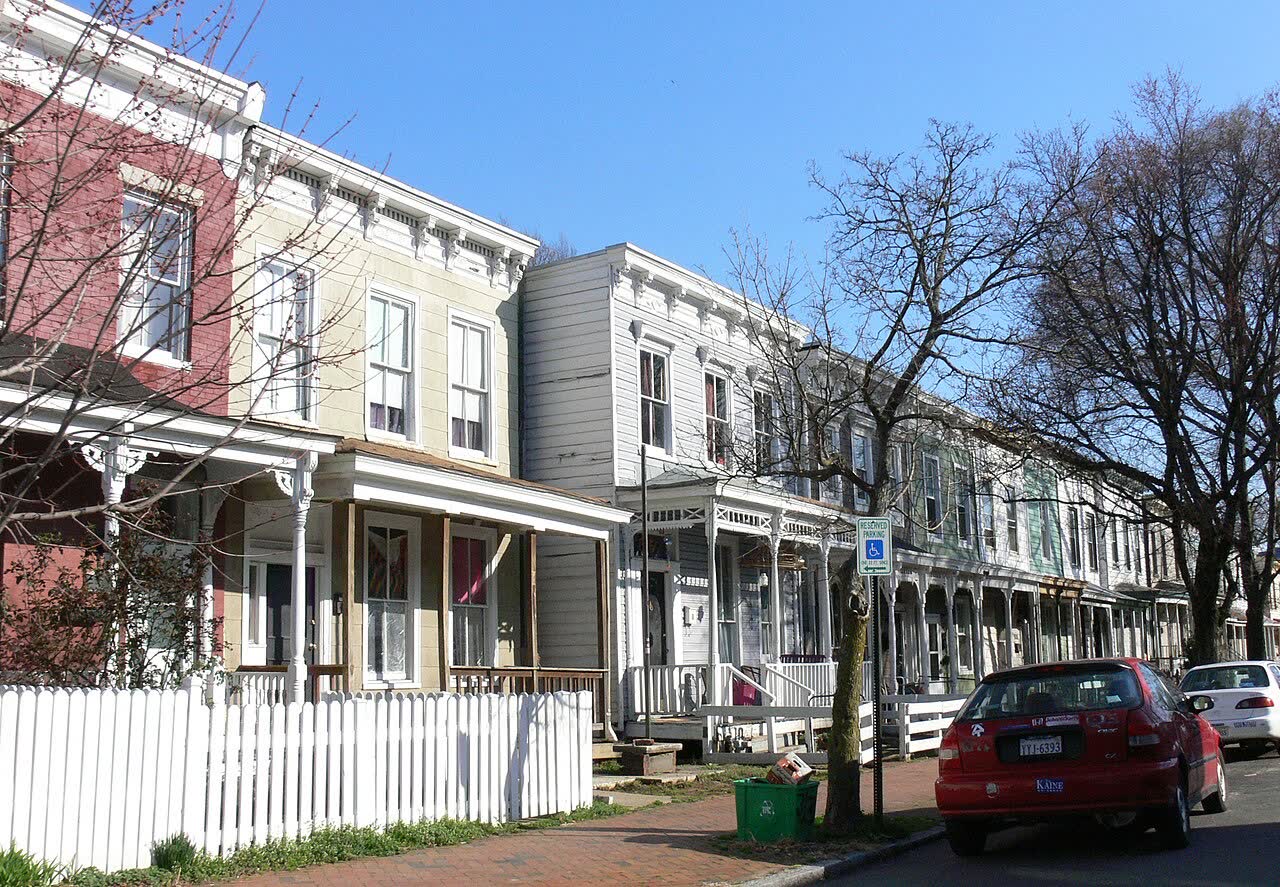

In a pre-1940 Richmond house, the plumbing to check first is the water service line, which may be lead or galvanized steel, then the cast iron drains and the sewer line to the street, as of October 2026. Look up your address on the City of Richmond's Service Line Inventory map. The City must remove lead service lines it controls by 2037 under a federal rule.
Why this matters more here than in the suburbs: the Census Bureau's 2024 American Community Survey estimates 27.7% of homes in the City of Richmond were built in 1939 or earlier, against 2.0% in Henrico County and 1.4% in Chesterfield County. Parts of the City's sewer system are more than 150 years old, according to its Department of Public Utilities (DPU).
This guide is for City of Richmond addresses on DPU water. If your water bill comes from Henrico or Chesterfield, those counties run their own utilities, so check with them. For licenses, permits and contracts on any home job, start with our guide to hiring home services in Richmond.
Do I have a lead service line in Richmond?
Check the City of Richmond's online Service Line Inventory map at rva.gov/public-utilities/leadfreewater, as of October 2026. Type your address, click the dot and read the material listed for the City side and your side. If your side says "unknown," you can fill out the City's survey yourself or have a participating plumber do it free, within program limits.
What the labels mean, according to DPU's January 2026 FAQ:
- Lead or galvanized: Galvanized steel counts as a lead service line if it was ever downstream of a lead pipe, because it can hold lead.
- "Likely lead": The City predicted it from property records and other data but hasn't confirmed it by record or by looking. DPU says lead lines are more likely at older buildings, near historic districts and near other known lead lines.
- Unknown: Nobody has recorded it. A survey settles it.
Checking yourself usually means finding where the water line comes through the basement or crawl space wall, before the main shutoff valve. A plumber from the City's preferred list, posted on the Lead Free Water page, can do the check and survey at no charge, subject to the program's limits. Questions go to the Lead Free Water Program at 804-646-8600 or leadfreewater@rva.gov.
So check the map first. What it shows for your side decides whether you need a survey, a plumber or nothing yet.
Who is responsible for the water line, the City or the homeowner?
The City owns the part of your water service line in the public right-of-way, and you own the part on your property, as of October 2026. The water meter usually sits near the dividing point. Everything inside the house, from the shutoff valve to the faucets, is the owner's responsibility, per DPU.
That split matters for lead. DPU says it's responsible for removing lead on the City side. For the customer side, the City is using outside grant money and asking owners for permission to replace their part along with its own. If you replace your side first, DPU asks you to call right away so it can check the City side and replace it if needed. A lead line half-replaced is still a lead line.
Will the City of Richmond replace my lead service line?
Eventually, block by block, if grant funding holds. As of October 2026, DPU says it's moving to a targeted, block-by-block approach and plans to start its replacement strategy in 2027. Disadvantaged neighborhoods, residential blocks, blocks with other utility work scheduled and blocks with better data come first. The individual grant program is taking very few applications.
The record so far, from DPU: the City started replacing public-side lead lines in the early 1980s. A state-funded grant for private-side replacements began in 2018 and, with federal ARPA money, has helped replace nearly 600 lead service lines and paid out more than $1.5 million to property owners. That money reached capacity, which is why the current program is limited.
So what are your options today?
- Wait for the block program. Free, but no date for your street yet.
- Replace your side now with a licensed plumber and a City plumbing permit, then call DPU.
- Reduce exposure meanwhile. DPU's advice: use cold water for drinking and cooking, run the tap after water has sat for several hours, clean faucet aerators and use a filter certified to remove lead.
DPU adds that its water leaves the treatment plant without lead and that it has run corrosion control for decades. Its summer 2025 sampling found corrosion control working and met Virginia Department of Health requirements. Lead gets in from service lines and household plumbing. DPU also notes lead solder was banned in 1986 but may still be in older homes. If you're worried, a certified lab can test your water for a fee.
What fails in the plumbing of a pre-1940 Richmond house?
The usual trouble spots in an older Richmond house, as of October 2026, are the water service line (lead or galvanized), galvanized supply pipes inside, cast iron drain and vent stacks, and the sewer lateral running to the City main. Each has a different owner, a different fix and sometimes a different permit.
How to approach each one:
- Galvanized supply pipes. Steel pipe with a zinc coating. Low pressure at upstairs fixtures or rusty first-draw water are reasons to have it looked at. Under DPU's definition, galvanized pipe downstream of lead is treated as lead.
- Cast iron drains. Ask the plumber to look at the main stack in the basement and any horizontal runs. A camera inspection shows the inside.
- The sewer lateral. The pipe from your house to the sewer main in the street or alley. Slow drains throughout the house, or a backup at the lowest fixture, point here.
- Combined sewers. Parts of the City's sewer system, some more than 150 years old, were built as a combined system that carries wastewater and stormwater in the same pipes, DPU says. In heavy rain the flow can exceed what those pipes hold.
Opening a wall in a house this age often turns up more than one of these at once. Ask the plumber to put any extra work in a written, signed change order before doing it, which Virginia requires anyway for licensed contractors.
Who pays to fix a sewer backup in Richmond?
It depends where the blockage is. We could not find a current City of Richmond page, as of October 27, 2026, that marks exactly where an owner's sewer lateral ends and the City's begins. So call 3-1-1 first when a sewer line backs up. DPU can check its main before you pay a plumber to dig.
Some practical points:
- Call the City first if more than one house on the block is having trouble or the backup came with heavy rain. That points to the main, not your line.
- If the City's main is clear, the problem is likely on your side. A plumber with a camera can find where the line is blocked or broken before anyone digs.
- Ask for the footage. The camera recording shows where the problem is relative to your property line. Keep it.
- Any digging in the street or sidewalk involves City right-of-way, so ask the plumber who handles that permit.
Do I need a permit for plumbing work in Richmond?
Yes, for most plumbing beyond simple repairs. As of October 2026, the City of Richmond issues plumbing work under a separate trade permit from the building permit, through its Online Permit Portal. Residential permit fees start at $63 for work valued up to $2,000, plus $6.07 per $1,000 or fraction above that and a 2% state surcharge.
A few City specifics:
- Value is set by the City's rule, the higher of the contractor's estimate or an RS Means price.
- Shower pans. The City no longer inspects the shower liner test itself. The installer runs the test and the contractor or owner hands the inspector a completed test certificate at the final building inspection.
- Help desk: 804-646-4169 or PDRPermitsAndInspections@rva.gov.
Ordinary repairs are exempt under the Virginia Residential Code, but replacing a water heater, a service line or a sewer lateral is the kind of job to confirm with the City before work starts. In Henrico and Chesterfield, permits go through each county; their offices are listed in our pillar guide. In a City Old and Historic District, interior plumbing doesn't need CAR approval, but anything new on the outside that's visible from the street may. See our historic district renovation guide.
What license should a plumber have in Virginia?
A plumbing company in the Commonwealth of Virginia needs a DPOR contractor license with the PLB (plumbing) specialty, as of October 2026, and its qualified individual must hold a master plumber license. The license class has to cover the job's value: Class C for jobs over $1,000 and under $30,000, Class B under $150,000, Class A above that.
Watch for a general remodeler doing the plumbing. DPOR's home improvement (HIC) specialty "does not provide for electrical, plumbing, HVAC, or gas fitting functions." If a remodeler is replacing your bath, ask who holds the PLB license and pulls the plumbing permit.
Check any license on DPOR License Lookup. Our guide to hiring a general contractor in Virginia covers what has to be in the written contract.
Where do I find a plumber who works on older Richmond houses?
Start with Local2RVA's ranked best plumbers in Richmond, VA, which shows the DPOR checks we ran and when, or browse every plumber in our directory serving Richmond, Henrico and Chesterfield, as of October 2026. For a lead line survey at no charge, use a plumber on DPU's preferred list.
Questions worth asking any plumber about an older house:
- Have you done service line surveys for the City's Lead Free Water Program?
- Will you camera the sewer lateral before recommending a dig, and give me the recording?
- Who pulls the plumbing permit, and is it in the contract?
- If you find galvanized or lead on my side, will you call DPU about the City side?
Living in an older neighborhood? By our count from Census tables, about 63 percent of homes in Church Hill's residential tracts, 66 percent in the Fan and 61 percent in the Museum District were built in 1939 or earlier. Ask any plumber how many houses of your era they've worked on this year. City water, sewer and trash basics are on our City of Richmond page.